- Sep 9, 2025
E-Newsletter #17
- The Team 😊
- 0 comments
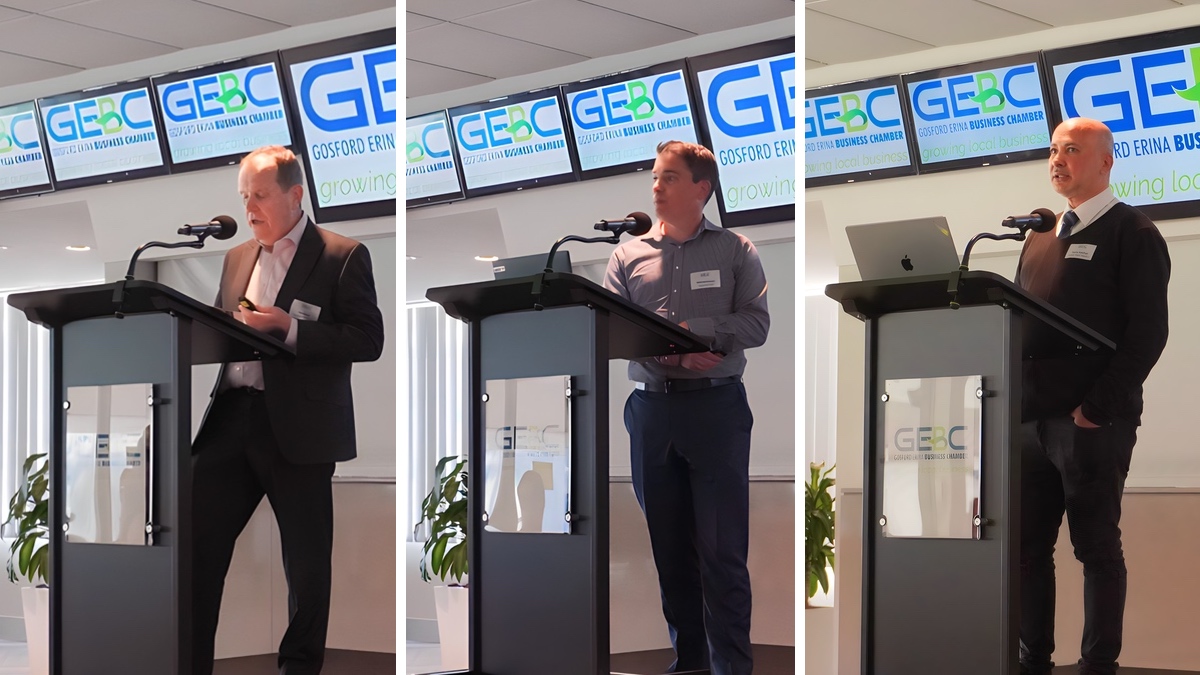
Tim Parker, Nick Buchanan, and Sasha Kanthan present at the GEBC luncheon on the Central Coast.
Central Coast WaterBUS Project featured at GEBC luncheon
In August, the Central Coast's Brisbane Waters WaterBUS was featured at the Gosford Erina Business Chamber (GEBC) luncheon alongside representatives from the High Speed Rail Authority and Transport for NSW. The GEBC aims to create a vibrant regional capital that will support business and the community through facilitating appropriate engagement with and between all stakeholders.
High Speed Rail advancements
Tim Parker, CEO of the High Speed Rail Authority, outlined the progress of the high-speed rail project connecting Melbourne to Brisbane via Australia’s eastern seaboard. The initial focus is on the Sydney-to-Newcastle route, passing through Gosford, which aims to cut travel time between Gosford and Sydney to just 30 minutes. This initiative addresses growing congestion on the existing railway line and M1 Pacific Motorway. Parker emphasised that the trains will be built locally in new advanced manufacturing facilities, aiming to revive Australia’s heavy manufacturing industry and create new opportunities in the technology sector.
NSW regional transport strategy
Nick Buchanan, Senior Transport Manager at Transport for NSW, discussed the ongoing development of the Strategic Regional Integrated Transport Plan (SRITP) for the Central Coast, one of nine regional plans across NSW. The draft plan, which aligns with the state government’s broader transport objectives, was open for public consultation earlier this year, with submissions closing in July. The finalised Central Coast SRITP is expected to be released later this year.
WaterBUS: A new transport solution
Sasha Kanthan, Project Coordinator for Brisbane Waters WaterBUS, highlighted the project’s potential to offer a competitive and sustainable alternative to private vehicles and established public transport options. A key challenge for public transport on the Central Coast is the inconvenience of "first and last mile" connectivity compared to driving. The proposed waterbus service, operating across the Brisbane Water, would provide a high speed route between coastal communities, bypassing the limitations of the rail network and the need for multiple bus stops on extended suburban routes.
Electric hydrofoils revolutionise global ferry transport
The adoption of zero-emission electric passenger hydrofoils is surging worldwide, driven by their cost-saving potential and environmental benefits. With fuel, labor, and maintenance being the primary expenses for transport operators, electric hydrofoils like the Candela P-12 and Vessev VS-9 are slashing fuel and maintenance costs by up to 90% while offering unparalleled route flexibility. This efficiency is sparking a global renaissance in maritime passenger transport and the Central Coast has an opportunity to join the wave.
Sweden: Stockholm’s public transport system has embraced the Candela P-12, a 30-passenger electric hydrofoil, for its pilot route between Ekerö and Stockholm City Hall. The 15 km journey now takes just 30 minutes, halving the previous 56-minute commute by bus or diesel ferry. This has boosted ferry ridership by 30%, with 80% occupancy, as commuters enjoy faster, greener travel.
New Zealand: Auckland’s tourism operator Fullers360 has deployed the Vessev VS-9, a 10-passenger electric hydrofoil, for scenic routes across the Hauraki Gulf. Tourists are flocking to experience the surreal sensation of “flying” above the water, with the vessel’s minimal wake preserving the environment.
United States: Candela has opened its first US office in Sausalito (across the bay from San Francisco) and is planning a manufacturing hub to meet growing demand. FlyTahoe, a Lake Tahoe tourism and transport operator, has ordered a Candela P-12 electric hydrofoil ferry to provide a sustainable, zero-emission transport option connecting the north and south shores of Lake Tahoe, enhancing eco-friendly travel for visitors and locals.
India: JalVimana, a Mumbai-based water transport operator, has ordered eleven Candela P-12 electric hydrofoil ferries to serve high-traffic routes from the Gateway of India to Alibaug and Elephanta Island, significantly reducing travel times compared to road journeys. A future line is planned to connect the new Navi Mumbai International Airport with central Mumbai, enhancing sustainable and efficient commuting options across the city’s waterways.
Saudi Arabia: Futuristic NEOM project has ordered eight Candela P-12s to navigate its planned water network, aligning with its vision for sustainable urban development.
Germany: Berlin’s Reederei Riedel has ordered a Candela P-12 for the 10-minute route between the East Side Gallery and Funkhaus, cutting commute times and easing road congestion.
Japan: Osaka is exploring a feasibility study for electric hydrofoils operating across its urban waterways, aiming to reduce congestion and emissions.
With hydrofoils reducing energy consumption by 80% and enabling high-speed, low-wake travel, cities worldwide are rediscovering their waterways. Could the Central Coast harness this technology to transform our local transport system? The future of sustainable transport is here, and it’s time to take flight.
Hydrofoils: No ordinary speedboat
The concept of hydrofoils, vessels that use wing-like structures beneath the hull to lift the boat above the water’s surface, reducing drag and increasing speed, was first patented in 1869 by French engineer Emmanuel Denis Farcot. His British patent described attaching inclined planes or wedges to a rowing boat to achieve lift, marking the earliest documented application of hydrofoil principles. His design laid the groundwork for future innovations. Decades later, in 1906, Italian engineer Enrico Forlanini successfully tested a practical hydrofoil boat on Lake Maggiore, demonstrating the technology’s potential to revolutionise water transport.
By the mid-20th century, hydrofoil technology advanced significantly, driven by military and commercial interests. During the 1940s and 1950s, German and American engineers refined hydrofoil designs, with the U.S. Navy developing models for speed and stealth during the Cold War. The Soviet Union also embraced the technology, launching the "Raketa" in the late 1950s, a commercial hydrofoil ferry that became iconic for passenger transport across rivers and seas. These vessels, capable of high speeds with reduced fuel consumption, gained popularity in Europe and beyond, particularly for short-distance routes where their efficiency outshone traditional boats.
Despite their early success, hydrofoils faced challenges that limited their widespread adoption. The rise of faster jet aircraft and high-speed catamaran ferries in the late 20th century diminished their commercial dominance. However, hydrofoils remain in use for niche applications, such as passenger ferries in regions like the Mediterranean and Hong Kong. Modern advancements have revitalised interest, with new designs incorporating lightweight materials like carbon fiber, advanced robotics, and electric propulsion systems, making hydrofoils more sustainable and efficient for specialised maritime transport in the 21st century.
What's next for September 2025? ✨
This month, we're advancing our mission to bring high-speed, zero-emission water transport to the Central Coast's waterways by navigating venture capital to fund innovative electric hydrofoil solutions.
If you have not already done so, please remember to share details of the waterbus project with family, friends, and colleagues.
Thank you for your continued support of the Brisbane Waters WaterBUS initiative. Together, we’re creating meaningful change for our community!
Subscribe to our free e-newsletter 🗞️
For exclusive news, insights, and opportunities to get involved.
Our journey together
Connection. Commitment. Community. 🌤️
We acknowledge the traditional custodians of the Central Coast region. We recognise their continuing connection to land and sea. We pay our respects to elders past, present, and emerging.